

Welcome to the first issue of The CHRO Office Every Thursday, I send one playbook to your inbox. This is your weekly signal, designed to help CHROs and HR leaders cut through the AI noise. Each issue delivers real-world AI use cases and actionable frameworks to help you stop being a support function and get a seat at the strategy table.
The function of HR is in a systemic crisis.
I spoke with a CHRO at a multi-hundred-billion-dollar global retailer who told me something simple but powerful:
This is not a moment for HR to lean back. It’s a moment to lean in.
She’s right.
Because leaning back is how HR got into this mess.
You, the leaders in this space, are facing challenges that have nothing to do with your capability and everything to do with broken power dynamics and flawed organizational design.
You are being scapegoated.
You are tasked with fixing burnout in a system that lionizes 80-hour weeks. You are asked to champion culture while reporting to a CFO who sees your entire function as a line item to be cut.
But now, the ground is shifting. A year ago, the conversation was about AI assistants. Today, it’s about agents. Companies are already building internal agent platforms that connect HRIS, payroll, and compliance to run processes in real time.
This is not an IT problem.
This is an org design, talent management, and change management problem. It is the central HR problem.
And here’s the paradox:
This new tech is your leverage. It’s the tool that finally allows you to escape the administrative trap. Yes, it will disrupt tasks, but it creates the space for HR to finally lead on what’s human:
Culture
Strategy.
Leadership.
The future of HR is people-led and tech-powered. This is the playbook for those ready to lean in. This is how you stop being a support function and start building the operating system.
The HR Crisis
The pain you feel is by design. It’s built into the org chart.
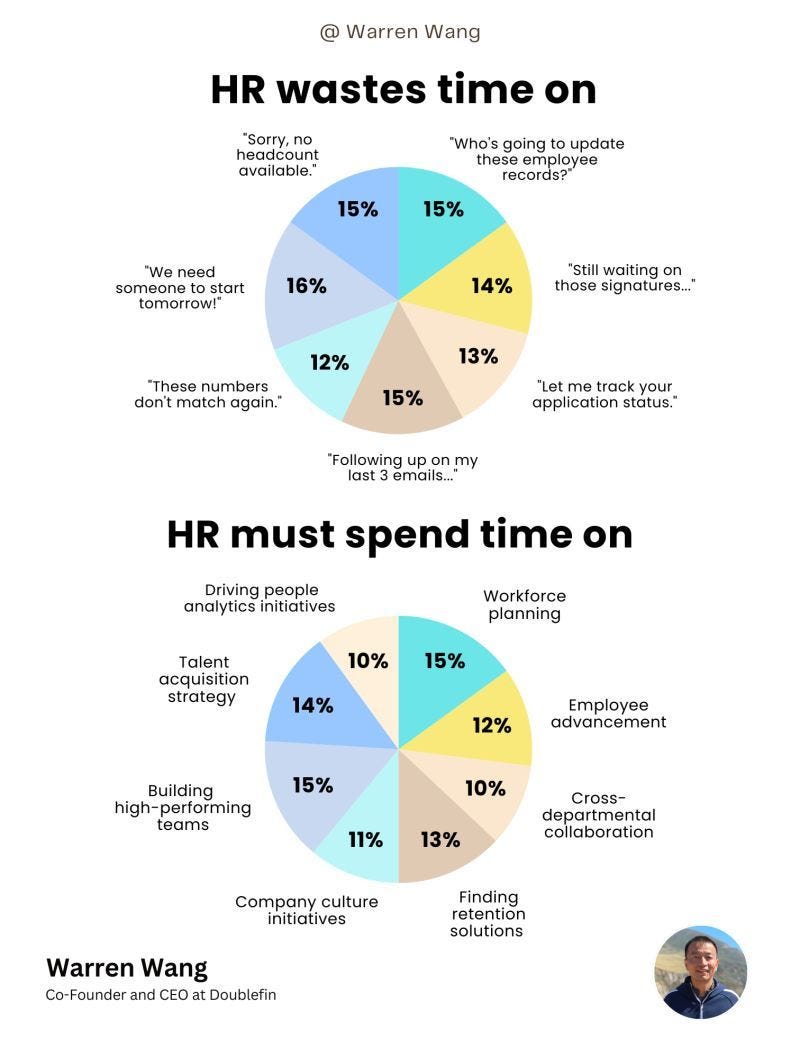
How often are your decisions undermined?
When employee backlash over a tone-deaf policy hits the press, who swoops in?
Not you. The CEO or CFO overrides or apologizes, implicitly casting you as the fall guy. When Activision’s CEO had to disavow his own company’s initial response to a crisis as tone-deaf, he was, by definition, throwing his own leadership team under the bus.
You are the burnout scapegoat.
We asked HR to fix burnout while rewarding overwork.
Executives praise the all-nighters, then dump every wellness problem on your desk and walk away.
Burnout worsens. Mentions of it in Glassdoor reviews spike 73% YoY. And you get blamed for failing to magically resolve a contradiction you didn’t create.
This dynamic has real consequences. HR burnout and turnover are surging.
54% of HR pros are burned out.
34% plan to quit the field entirely.
CHRO turnover is 9%, outpacing the rest of the C-suite.
HR managers are now the most likely group to take stress-related leave.
Why? Because you’re playing a game that’s rigged against you.
Your budgets are a joke. HR functional spend is, on average, 0.74% of revenue. That is half of Finance and one-seventh of Sales.
You are measured on narrow, tactical inputs (time-to-hire) while being held accountable for vast, strategic outcomes (culture, engagement).
It’s a fundamental OKR misalignment.
Want to see the misalignment in action?
Look at Amazon’s unregretted attrition (URA) target of 6%. Internal documents revealed unrelenting pressure on managers to meet this quota. If a team only lost 3%, the directive was to make up the difference the next year.
This is the definition of an untenable position. HR is asked to improve retention while the systemic goal is to cycle out 6% of the staff annually. The structure is literally working against you.
Look at the org chart.
Where do you sit?
If you’re one of the 39% who don’t report to the CEO, you’re already sidelined.
If HR reports to Finance, the company has officially labeled culture as a cost center.
Don’t be shocked when it gets cut.
Your identity crisis ends when you stop taking the blame for a system you didn’t design. It ends when you stop asking for a seat at the table and start building a new one.
From Assistants to Agents: Your New Leverage (and Your Greatest Risk)
The rise of AI copilots and process automation is your once-in-a-generation chance to restructure people operations. This is your leverage.
Seize it, or watch IT and Finance co-opt it.
The warning is this: If IT owns the agent, IT owns the employee experience. HR becomes a stakeholder in its own function.
Your new job is to lead the deployment of internal AI agents for HR workflows. Stop being a manual gatekeeper. Start being the architect of autonomous, end-to-end runs.
Pioneers are already proving the model.
A global enterprise used an automation platform (Tonkean) to orchestrate its onboarding. When a new hire hits Workday, an AI agent kicks in:
It generates a personalized onboarding plan, pulling from internal docs.
It engages managers via Slack to co-create 30-60-90 day plans.
It acts as a virtual HR assistant, instantly answering policy questions.
The Outcome: Onboarding time for contractors was slashed from 20-30 days to under 5 days. New hires raved that the process felt like 3-4 people worked on it. AI handled the lift.
This is about time, cost, and credibility.
Time & Cost: By automating 280 routine HR tasks, IBM’s HR team saved 12,000 hours in 18 months. That’s the work of ~6 full-time employees, handed back to HR to focus on strategy. The CFO loves that.
Cycle Time: A global food manufacturer deployed 650 AI bots. Approvals that took weeks now take hours. They reported a 60% reduction in project approval times.
Imagine telling your COO that hiring approvals now take 2 days instead of 10 with a full audit trail because HR led the automation charge.
That’s how you change perceptions.
The old way was spaghetti: forms, emails, and manual hand-offs.
The new way is a sleek, trigger-action flow.
A hiring manager hits approve and an agent generates the offer, gets the e-signature, provisions IT accounts, and ships the laptop. HR is only pinged for exceptions.
Policy without automation is theater.
Automate it or admit you’re role-playing.
Think about your mandatory Code of Conduct training. Stop nagging. Build an agent that messages employees, records acknowledgment, and if the deadline passes, automatically notifies their manager and locks them out of the system until it’s done.
Suddenly, the policy isn’t theater. It’s a living workflow.
This is the power shift. HR becomes the designer of autonomous systems, not the administrator of manual ones. Less drudgery, more control.
But the risk is real.
IT is already implementing bots for expense approvals.
If you don’t own the AI-driven processes for your people, you will cede the territory.
HR as Operating System: The Anti-HR HR (Four Rewires)
If bureaucracy is damaging your credibility, the antidote is to rebuild HR as a lean operating system for the organization.
The Anti-HR HR doesn’t cling to processes for process’ sake. It deletes them. It rewires how work gets done.
1. Build the Anti-HR Workflow (Automation by Default)
Stop being process gatekeepers. Start being process designers.
List your top 5 time-consuming workflows. Now, which can you delete or auto-run?
Manager Approvals: One company found 95% of promotion recommendations were approved with no changes. They eliminated one entire layer of approval. Result: Average approval time went from 3 weeks to 3 days.
Internal Transfers: Stop treating internal candidates like strangers. Build an internal market. An org that did this saw internal transfer fill time drop from 30 days to under 10 because the “approval” was baked into the system.
Compliance Nudges: One company used its HRIS to send weekly training reminders and auto-enroll anyone who hadn’t finished. Completion rates jumped from 40% to 90% with zero HR phone calls.
If your process requires an HR touch every single time, you built a moat for your job, not value for the business. The Anti-HR HR mindset is to celebrate not touching things. Show them HR is an efficiency driver, not a bureaucratic moat.
2. Break the Career Game (Make Talent Liquid)
Org charts are political maps, not talent maps. They silo talent until it withers and leaves. The Anti-HR approach is to create an internal talent marketplace that treats skills as currency.
The (Unilever): Unilever’s FLEX Experiences marketplace allowed them to redeploy staff in days during the pandemic. In two months, they staffed 700 critical projects, unlocking 26,000 hours of capacity that would have been lost.
The Outcome: By 2022, that number was 700,000 hours unlocked and a 41% productivity improvement attributable to this talent fluidity.
The Reality: Companies with active internal markets (Walmart, PepsiCo, Nestlé) are crushing the “Great Resignation.” Why? Employees are 2/3 more likely to leave if they don’t see internal mobility.
Pilot this now.
Staff one critical project with 10%-time internal gigs. Show your exec team you staffed it in 1/3 the time, saved $Y in recruiting costs, and kept your people engaged. You will be reframed from recruiting admin to talent economist.
3. Corporate Psychology Arbitrage (Rewire Contexts, Not People)
Stop trying to change people with culture decks. Change the environment they operate in. Tweak the defaults.
The Receipt (Meetings): A company realized meetings were the source of burnout. They didn’t run a better meetings training. They changed the context.
All recurring meetings must have pre-reads 48 hours in advance.
“Cold opens” (surprise topics) were banned.
Default meeting length was set to 30 minutes, not 60.
The Result: A measured 35% reduction in total meeting hours and higher engagement scores. They didn’t preach “value others’ time”; they changed the rules so the system encouraged it.
Culture decks are sermons. Change the defaults or stop preaching. Run A/B tests. Make one training opt-out instead of opt-in; watch completion rates jump from 60% to 90%. Publish a quarterly “HR Arbitrage Log”: “Eliminated forced-ranking. Team collaboration scores rose 10%.”
4. Own the Money Problem (Price Impact, Not Time)
Stop being a steward of payroll. Start playing on Finance’s turf. Quantify the value of great people and the cost of losing them.
Talent Economics 101: Build an Attrition Cost Model with Finance. The cost of losing one mid-level engineer isn’t their salary; it’s 1.5-2x their salary (SHRM, Gallup) in hiring, ramp time, team drag, and lost opportunities.
The Translation: “Losing Jane didn’t cost us $150k. It cost us $250K.” Now retention is a P&L issue.
Radical Compensation: Stop the secretive comp practices that breed mistrust.
Netflix: Pays top of personal market. Period. They pay you slightly more than anyone else would. This isn’t “nice”; it’s a brutal strategy to prevent regrettable losses.
Buffer: Publishes all salaries and the formula. Applications spiked 229%. 49% of their team have 5+ years of tenure—unheard of in tech—because employees trust the system.
If comp is politics, your best people are already job hunting. Make it a clear equation tied to impact.
HR + Finance + Strategy (Peers or Perish)
You will only transform your clout when you stand toe-to-toe with Finance and Strategy as an equal partner. That means using numbers, models, and forecasts.
Start by co-authoring an Attrition Cost Calculator with your CFO. Plug in your company’s data. When you present, Last year, voluntary quits cost this business $20 million, the conversation changes.
When Gallup estimates that U.S. businesses lose $1 trillion annually from turnover, your $20 million suddenly sounds conservative.
Create a joint HR-Finance dashboard. Review it monthly.
Hiring plan vs. actual (a delayed hire = delayed revenue).
Time-to-productivity for new hires (a P&L drag).
Regretted attrition rate and its cost.
Revenue per employee.
When you can show sales per employee rose 8% after our Q2 sales enablement program, you are no longer an HR leader. You are a business leader taking credit for margin improvement.
The CEO owns cash. HR owns belief. Strategy dies without both.
Start acting like it. Write a quarterly talent strategy memo:
“We propose hiring 50 more engineers for Product A, above plan.”
This will accelerate Feature X by 3 months, capturing an estimated $10M in revenue. Here is the cost. Here is the risk if we don’t.”
This is how a CFO proposes a capital expenditure. You are proposing a talent expenditure with a projected ROI.
When Mary Barra led HR at GM during its turnaround, she simplified the 10-page dress code to two words: Dress appropriately.
This wasn’t a fluff move. It was a strategic, CEO-level decision. She signaled a cultural shift to trust, cut management time spent on trivial enforcement, and empowered her people. She applied the agility and people-focus she championed in HR before she became CEO.
HR and Finance must be peers.
If you remain a supplicant begging for budget, you will remain on the sidelines.
The Takeaway
Stop talking about culture and start talking about the cost of attrition.
Stop asking for a seat and start presenting the opportunity cost of vacancy.
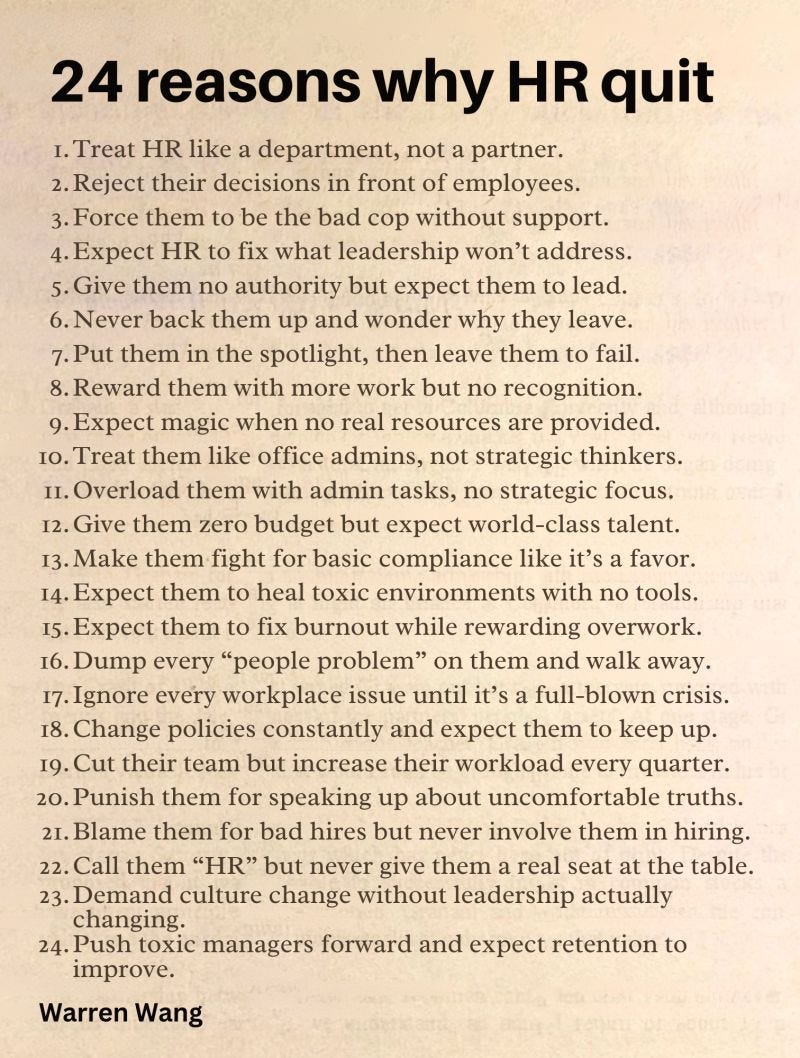
Your function’s identity crisis ends the moment you stop speaking the language of support and start speaking the language of the P&L.
The AI agent is your new leverage.
It’s the tool that automates the administrative work that made you a cost center. The time it frees up is the resource you will use to become a strategic driver.
Don’t just lean in. Take over.
And that’s all for today.
If you like this, reshare this newsletter on your LinkedIn.
I’m Warren Wang. CEO at Doublefin.com | Ex-Google | Ex-Microsoft | Helping HR advocate for its seat at the table.

Find me on LinkedIn
Congratulations on the first post! I’ve been eager to check out the first issue & it did not disappoint. These suggestions are actionable steps in my new role within the PE space. You’re helping me understand how to talk/present with the strategy lens for HR change proposals. I look forward to reading your future publications.
Very much insightful, Wang!